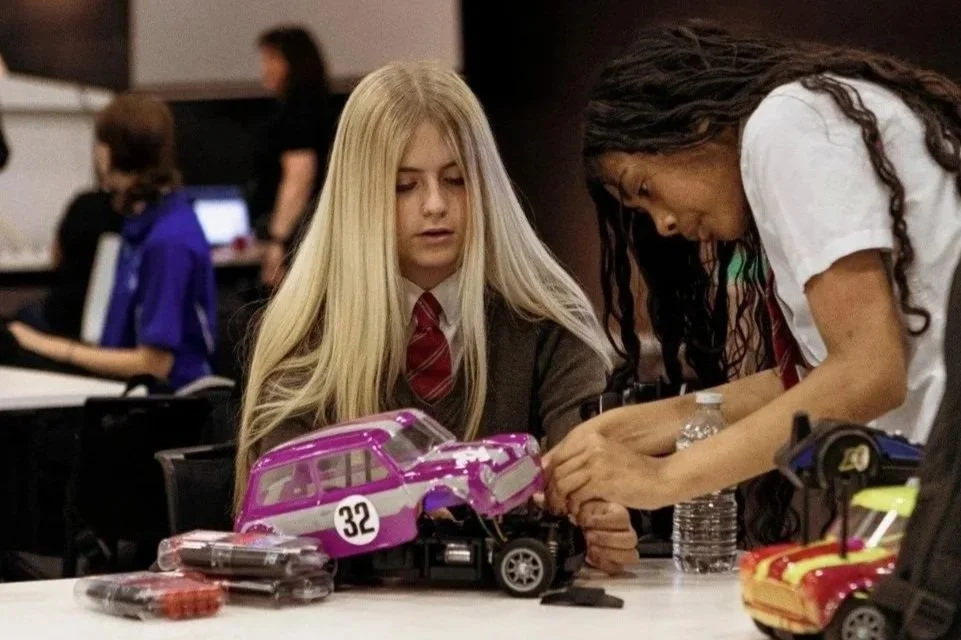
What Makes an RC Car Go Faster? The Answer Isn't Speed.
This piece has been forming for a while, but it's our recent work with a range of SEND schools, including receiving an impact statement from Orion Academy, brings one of our foundation ideas sharply into focus.
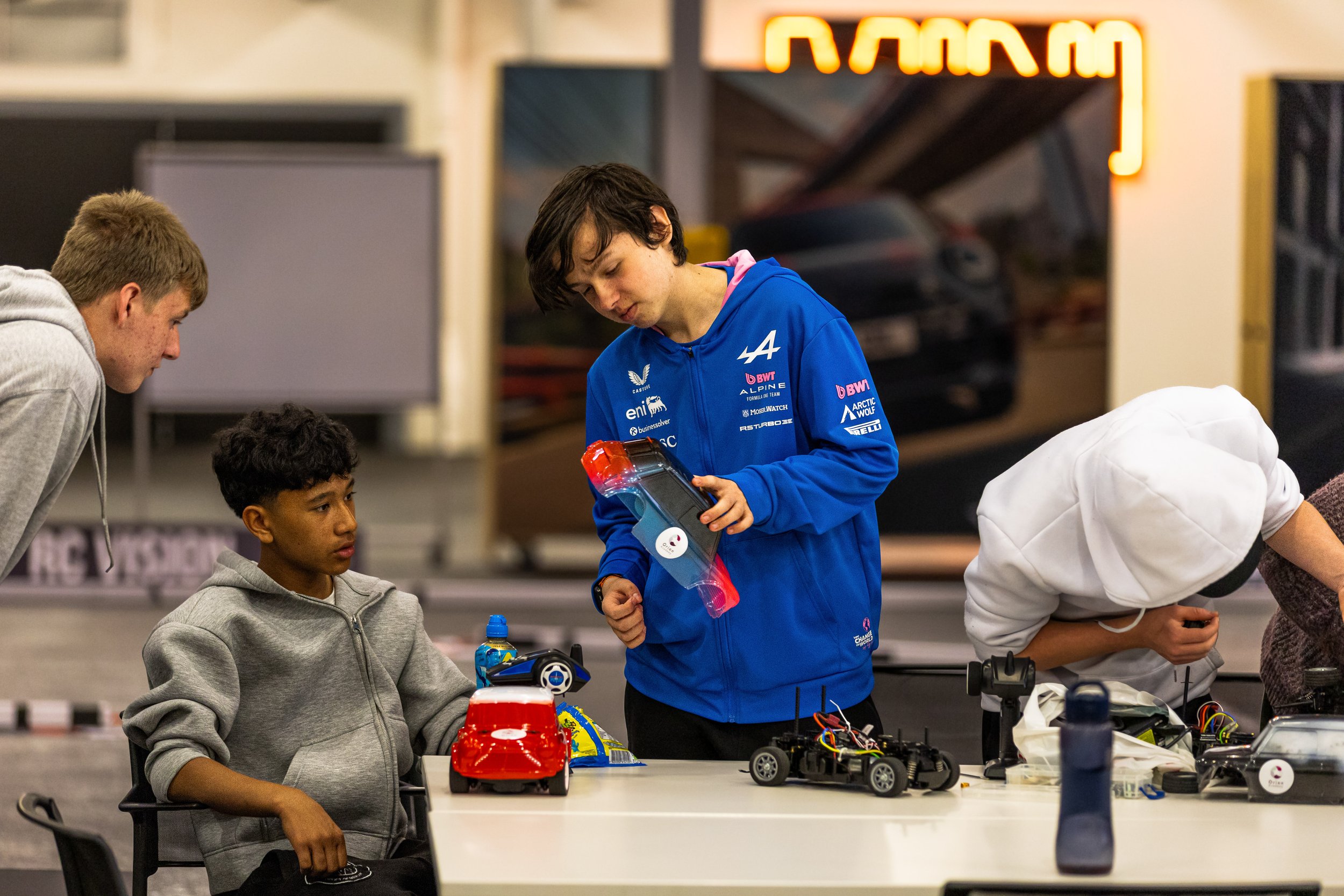
Ability, like inequity, arrives through different starting points. One student's breakthrough might be a personal-best lap; another's might be holding a steady line for the first time. If your only measure of success is who crosses the line first, you miss almost all of it.
Which is exactly why measurement — done properly — sits at the heart of everything we do.
When people first see RC Vision in action, they notice the racing. The noise, the competition, the cars flicking through corners at speed. They often ask “who is winning”. What they don't immediately see is that every race is an engineering experiment — not because we're teaching engineering, like in a lesson, but because we're teaching young people how engineers think.
The difference matters, and it starts with a single question.
A question that changes everything
At the start of every session, the challenge sounds deceptively simple: how can I go faster?
Most young people respond the way most adults would. They start offering solutions. Drive harder. Crash less. Use more power. It's instinctive — when you want to be faster, you push.
Engineers don't start with solutions. They start with questions. What if I slowed down. What if I changed my line through that corner? What if smoother was actually faster? Each of those ideas is a hypothesis, and a hypothesis is only useful if you can test it.
Why racing on its own isn't enough
This is the point where most hands-on STEM activities stop. Something gets built. It gets made to work. Job done — photo taken, certificate awarded, kit packed away.
But engineers don't just make things work. They make things work better. And the purpose of science was never simply to complete the experiment — it's to learn from the result, and to do something with what you've learned. That's the difference between an activity and an education. One ends when the thing works. The other starts there.
The same is true on the track. A young person makes a change, tries again, and reports back: "it felt quicker." But feelings aren't evidence. Human perception is a notoriously unreliable instrument — a lap that feels fast is often just a lap that feels dramatic. Without objective data, all we do is reinforce whatever we already believed.
Making things work better depends on measurement. So do we.
Every race becomes an experiment
This is why timing sits at the heart of every RC Vision session. We use LiveTime, professional race-timing software from LiveRC — not because we need a leaderboard, but because we need evidence.
Every race is a personal experiment. Each racer is testing their own hypothesis against their own baseline. Was my new line actually faster? Did braking earlier make me quicker overall? Was I more consistent than last time? Did I improve?
Instead of guessing, students know. The moment a hypothesis meets a lap time, play becomes experimentation — and every racer becomes their own experimenter.
Measurement changes the conversation
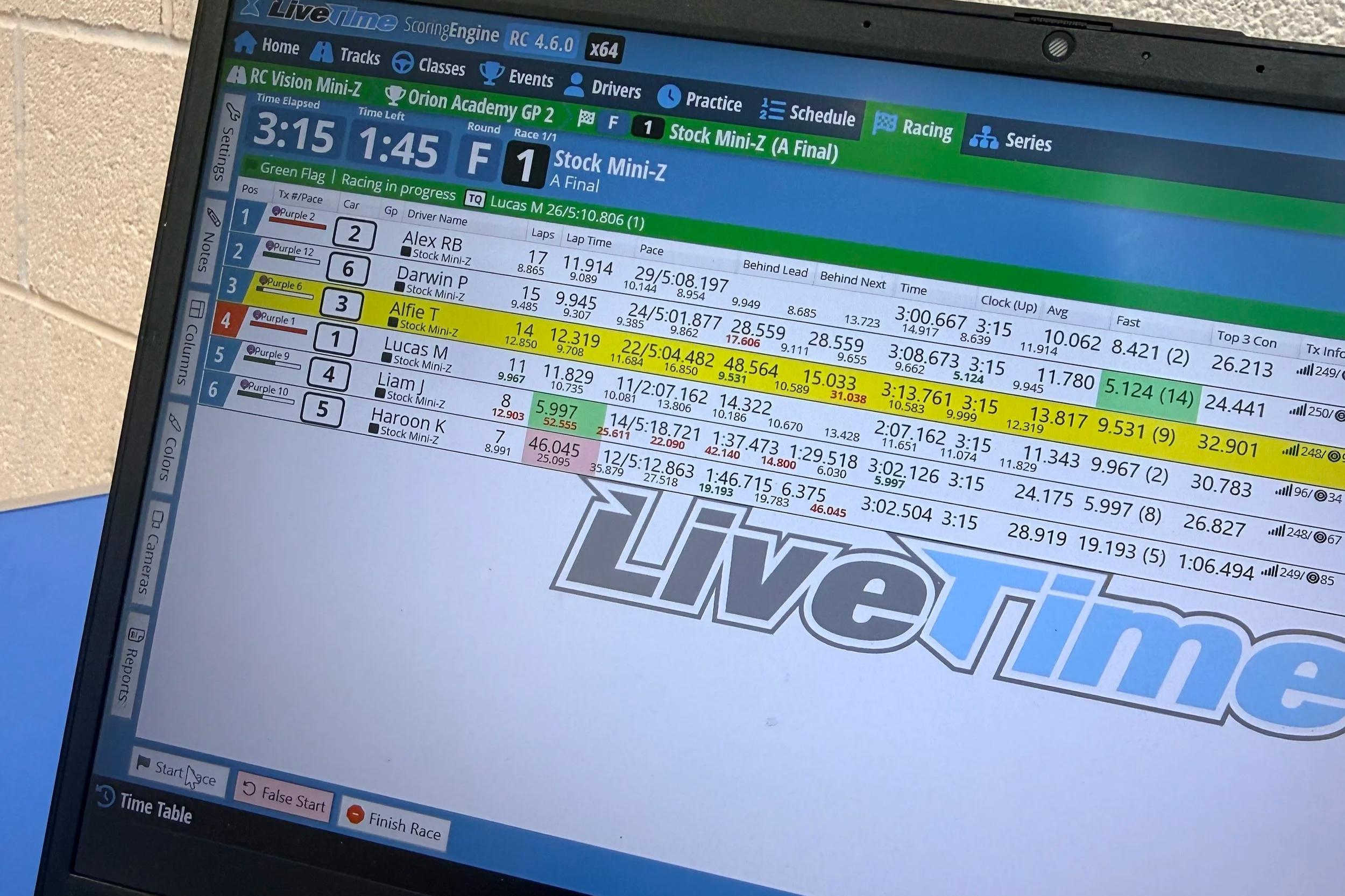
Most timing systems exist for one purpose: finding the winner. We use ours differently.
Because the Live Time software is fully configurable, we can measure whatever the learning calls for — fastest lap, best three consecutive laps, average lap time, consistency, race pace, or simply personal improvement from one run to the next. A student who might never top the leaderboard can still see, in hard numbers, that they knocked two seconds off their average and halved the gap between their best and worst laps.
That's what makes this fully inclusive. In any group — and nowhere more than in our recent SEND work — young people arrive with hugely different starting points. A race that only asks "who won?" excludes most of them before it starts. A race that asks "did I improve?" includes every single one, because everyone has a baseline and everyone can beat it. The student at the back of the field is running exactly the same experiment as the student at the front. The leaderboard only ever tells one story. The data tells thirty.
And so the questions around the track change. Not "who won?" but "what did you discover?" What changed? What will you try next? The competition is still there — it's what makes the room buzz — but the conversation underneath it is about evidence.
Why the research says this works
Educational research consistently identifies immediate, objective feedback as one of the most powerful drivers of learning. But something deeper is happening too.
When a young person can see that something they changed produced a measurably better result, they experience what psychologists call a mastery experience — the most reliable known source of self-belief. Instead of being told they can think like engineers, they prove it to themselves, lap by lap. That matters, because identity isn't built through encouragement. It's built through evidence.
Engineering Habits of Mind, in action
RC Vision's pedagogy is built on the Engineering Habits of Mind framework, developed by Professor Bill Lucas, Dr Janet Hanson and Professor Guy Claxton for the Royal Academy of Engineering. It describes the cognitive dispositions that characterise how engineers approach problems, and measurement naturally develops several of them at once: improving, adapting, problem-finding, systems thinking.
Watch it happen over a few sessions and you see a shift in the questions young people ask of themselves. They stop asking "am I good at this?" and start asking "what should I try next?" That is a profound change, and it travels well beyond the track.
The myth of talent
Perhaps the biggest lesson isn't about RC cars at all. It's about improvement.
Many young people believe in talent — that ability is something you have or you don't. The data tells a different story. The quickest drivers are still working incredibly hard for tiny gains, and finding one tenth of a second at the front of the field can be every bit as difficult as finding ten seconds at the back.
Improvement never becomes easy. It simply becomes more precise. That's a lesson worth learning at fourteen, because it replaces fixed ability with deliberate practice. Everyone improves from where they are. Everyone has another step to take.
More than a timing system
Without measurement, a race ends when someone crosses the finish line. With measurement, that's when the learning begins. Every race becomes evidence. Every improvement becomes visible. Every student gets to work like an engineer.
People sometimes assume RC Vision's innovation is using RC cars in education. It isn't. Our innovation is using engineering itself as the pedagogy. The cars are simply the environment in which young people repeatedly live the engineering cycle: question, hypothesis, experiment, measurement, reflection, improvement — and then round again.
The timing system just makes that cycle visible. Which is why, at RC Vision, timing isn't a piece of race admin. It's one of the foundations of how we teach.